
The request comes in
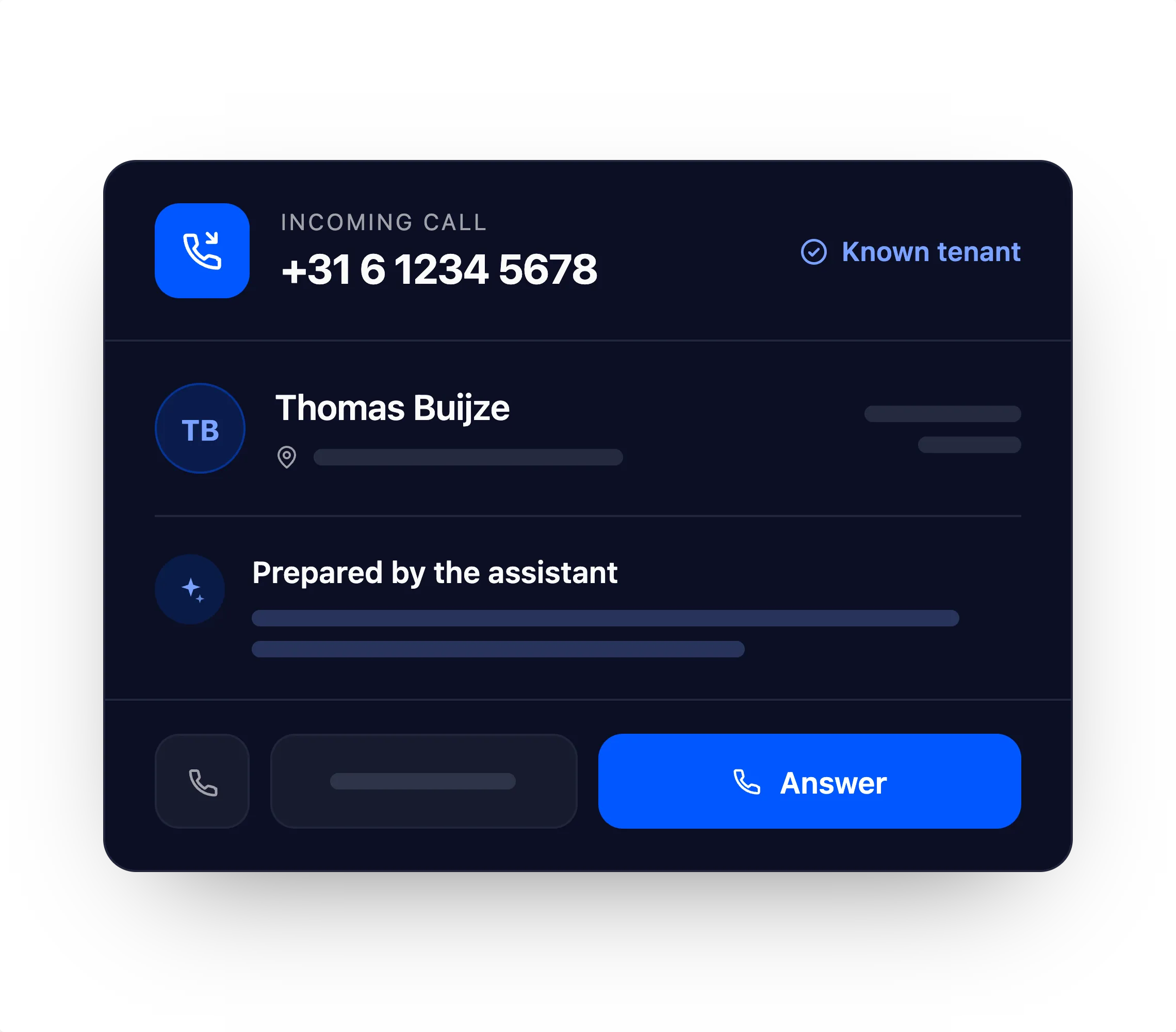
Tenant, address and open job sheets are ready before the call is answered.
The right answer, the right party, in a single phone call. For housing associations, property maintenance companies and HOA managers.
Book an introductionTenant, address and open job sheets are ready before the call is answered.
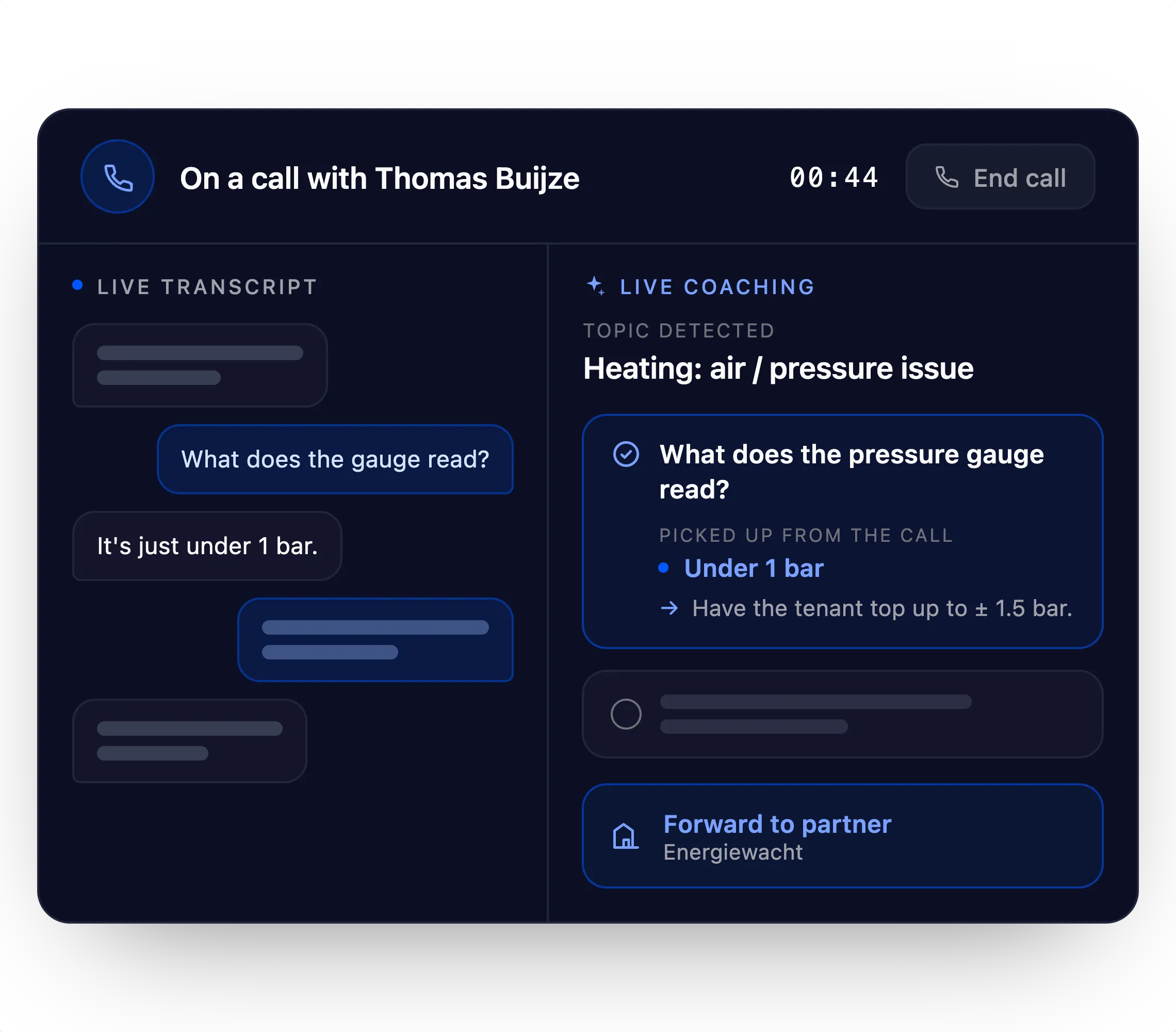
The call is matched against the knowledge base. The right follow-up questions appear, starting with whether the problem can be solved on the phone.
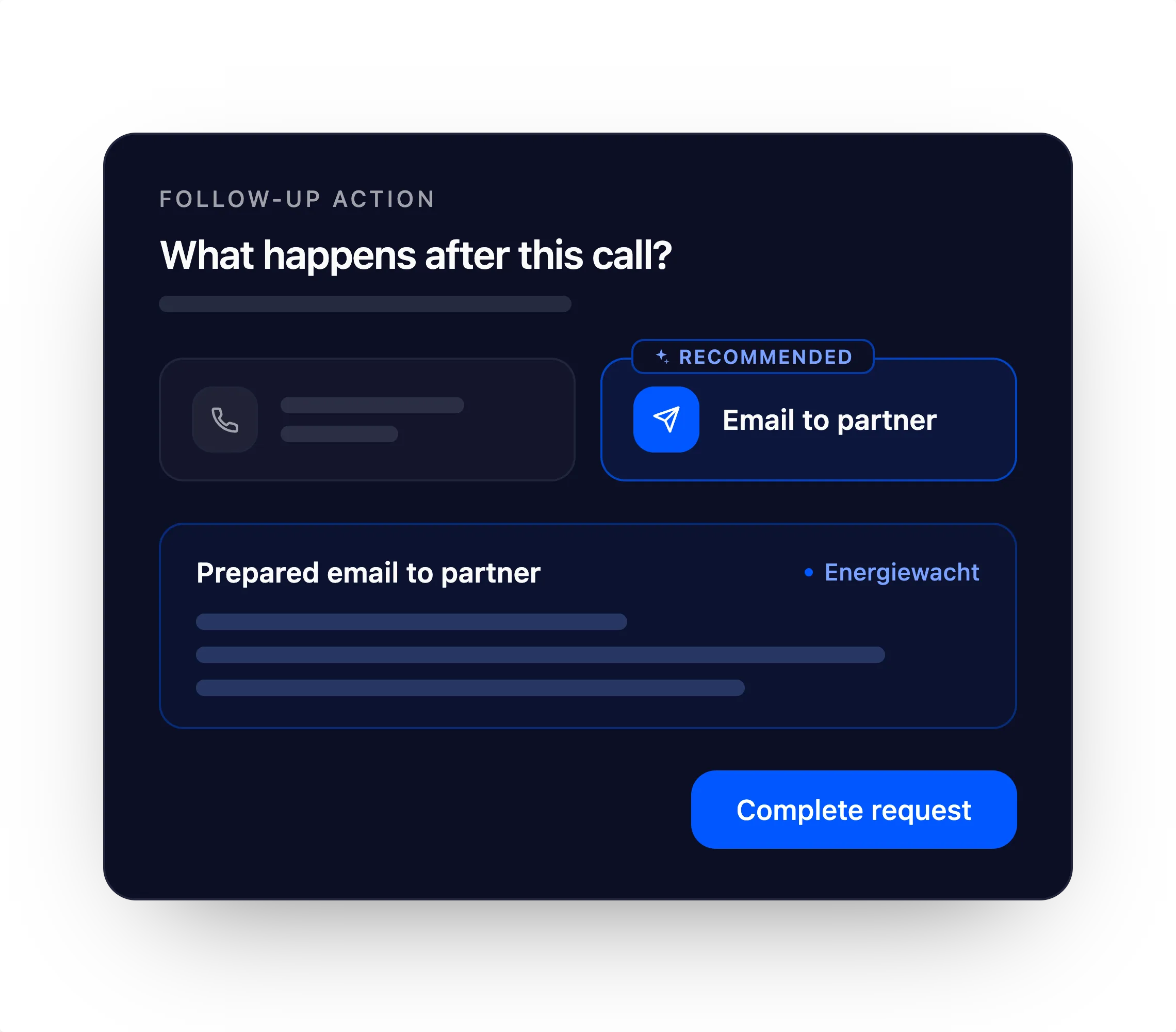
The tenant, your own team or the right partner. The work order or partner email is prepared.
Whoever answers the phone rarely has the technical knowledge to ask the right questions and route the request.
reports ‘the boiler is not working’
lacks the technical knowledge, records only the complaint
sends an engineer, without a fault code or context
arrives at the door with the wrong equipment
of repair requests cannot be fixed in one visit, purely because of what is not asked during the phone call
Every housing association has its own policy rules, building agreements and supplier contracts, and nobody can have all of that to hand. The problem is access to that knowledge at the moment of the call, not the employee who answers.
Your employee runs the call, Flixer supplies the knowledge. Three moments from the same call.
Tenant, address and open job sheets are ready before the call is answered.
The call is matched against the knowledge base. The right follow-up questions appear, starting with whether the problem can be solved on the phone.
The tenant, your own team or the right partner. The work order or partner email is prepared.
Internal policy and trade knowledge, translated into questions and decision rules the system applies live. The more data, the better it gets.
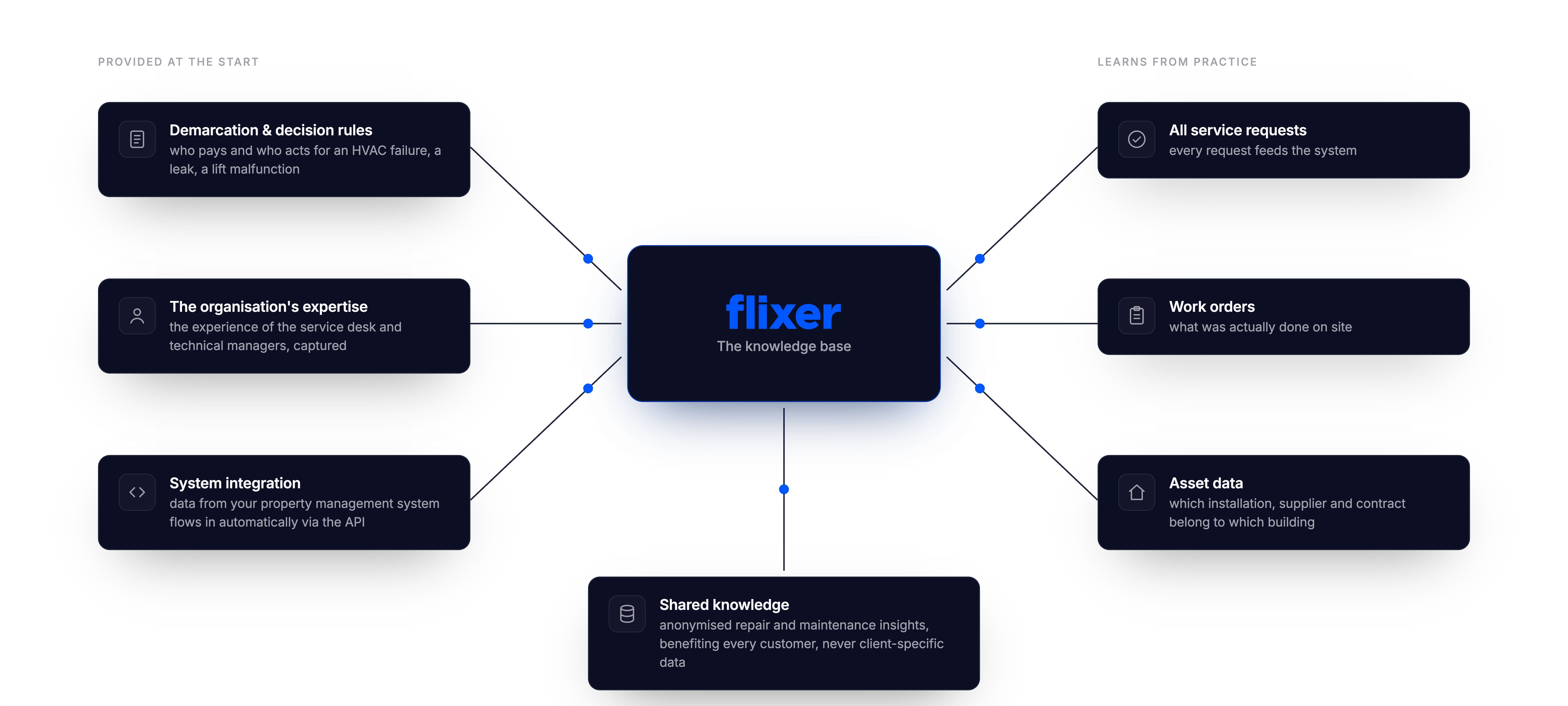
Shared knowledge: anonymised repair and maintenance insights, benefiting every customer, never client-specific data.
A model at 10,000 requests a year. During shadow mode we measure your own figures.
Adjust the three values to match your organisation.
Requests per year × percentage not resolved in one visit × cost per unnecessary visit
1.800 unnecessary visits per year
This is a model based on our own field figures, not a promise. During shadow mode we measure your own figures.
Drives to a job they cannot finish. The request goes back into planning.
Your own engineer on work the supplier should have paid for.
Whatever is not asked properly the first time calls back within a week.
Each phase has its own go/no-go, and minimal work for your IT department.
Listening in on the repair line. You receive a report on your own requests: where it goes wrong and what can be saved. Measured, not estimated.
One connection to the existing phone line.
Your maintenance policy becomes a working knowledge base, with live triage on the repair line. Followed by two weeks of tuning.
Nothing new. An ERP connection needs one-off API access and can follow later.
Live on every request, measured against targets agreed before the start and against the baseline from shadow mode.
Nothing.
What is settled before a single request goes through the system. The full policy is shared under NDA.
You sign a data processing agreement with Flixer Pro as processor and your organisation as controller. Sub-processors are named in its annex.
Application, database and storage run inside the EU (Ireland). Which suppliers those are, and the region each processes in, is listed per sub-processor in the annex to the data processing agreement.
TLS 1.2 or higher in transit, AES-256 at rest. Customer data is separated at the database layer with row-level security, not only in the application.
Role-based permissions, two-factor authentication you can enforce across your organisation, and single sign-on. Login and change logging, with an exportable overview of users and permissions.
A documented incident response policy with defined severity levels. Notification to the Dutch DPA within 72 hours where required, and you hear from us without undue delay if your data is affected.
The security programme is built to the requirements of the GDPR (Article 32), SOC 2 and ISO 27001. The full policy, including what is still in development, is shared under NDA.
Full information security policy, data processing agreement and sub-processor list available on request.
No. Your employee runs the call; Flixer supplies the knowledge at the moment it is needed. The follow-up questions and the suggested next action appear during the call, and the employee decides.
Yes. You sign a data processing agreement in which Flixer Pro is the processor and your organisation the controller. Sub-processors are named in its annex. The full information security policy is shared under NDA.
The application, database and storage run inside the EU (Ireland). The full sub-processor list and the region each processes in is in the annex to the data processing agreement, so you can review them by name before signing.
Our security programme is built to the requirements of the GDPR (Article 32), SOC 2 and ISO 27001, and the underlying hosting infrastructure is ISO 27001 certified. Flixer Pro itself does not currently hold its own ISO 27001 or SOC 2 certificate.
Yes. Flixer works alongside your existing software. You can start without an integration: during shadow mode, one connection to the existing phone line is enough. An ERP integration needs one-off API access and can follow later.
See live triage on your own requests.

We use cookies for analytics and advertising. More in our privacy statement.